If you're planning a safari trip, you might be wondering how you can make your experience more sustainable.
This guide helps you plan a Moremi Game Reserve mokoro and 4x4 safari, with practical advice on choosing flood-level routes, deciding when to switch from mokoro to game drives, and spotting the most reliable species by habitat.
Moremi isn’t a “one route fits all” destination. The Okavango Delta changes from week to week, and the best itinerary is the one that follows water—without pressuring wildlife or local access routes. Done well, a combined mokoro and 4x4 plan lets you experience the delta quietly by boat and then explore broader landscapes by vehicle when conditions favour it.
How Flood Levels Shape Your Moremi Plan

The basics of the Okavango flood pulse
In the Okavango Delta, seasonal flooding determines where animals gather, where boats can travel safely, and which vehicle tracks are passable. During higher water, more channels connect, and mokoro routes extend into areas that would otherwise be too shallow or dry. As water drops, those same channels narrow and can become interrupted by mud, sandbars, or exposed stretches.
In practical terms, your safari plan needs flexibility. Instead of assuming a fixed route, build your itinerary around “mobility rules”: what you can do in deeper water, what you can do when water recedes, and how guides will adapt when conditions change.
Picking the right zones inside Moremi
Moremi works best when it’s treated as a set of linked habitats rather than one uniform reserve. Along with your guide, you’ll usually base decisions on where your camp or starting point sits relative to channels and floodplain. Commonly visited areas include Xakanaxa and the broader channel system, plus the Khwai River / community-side habitats.
How access points affect vehicle versus boat travel
Where you enter the delta also influences the balance between mokoro and 4x4 time. Vehicle routes tend to follow firmer ground and established tracks, while mokoro travel depends on navigable water depth and calm, clear passage. When the flood is strong, boat travel often opens up more options; when the flood eases, vehicle drives typically become more important for reaching game-viewing areas.
Choosing Flood-Level Routes for Mokoro and 4x4 Days

Reading water depth and deciding on route options
Flood-level planning is mostly about judging whether a route is safe and sustainable for your mode of travel. For mokoro travel, shallow water can be risky: you can scuff sensitive banks, push into reeds at the wrong angle, or get stuck in soft bottom where the canoe can’t move efficiently. For 4x4 driving, the concern is different: after rain, even “normal” tracks can become slick, rutted, or waterlogged, which can damage ground and increase vehicle recovery risks.
Ask your guide to explain the route logic before you commit for the day. A well-run safari will describe which channels or edges they’re targeting, what the team expects to find there, and what the fallback option is if water conditions don’t match the plan.
Planning routes that avoid pressure on wildlife and people
Route choice isn’t only about what’s passable; it’s also about how you move through habitats responsibly. In floodplain systems, animals concentrate along edges: grass lines, channel banks, and island margins. Those same edges are where you can inadvertently create disturbance if you repeatedly linger or approach too closely.
A sustainable approach is to keep travel purposeful. For mokoro outings, that means staying attentive to drift and sound, and not “stalling” in one spot. For vehicle drives, it means using tracks that minimize ground damage and moving on when animals have been observed, rather than crowding a single sighting.
When to switch from mokoro to game drives
The switch point is usually not a calendar date; it’s a conditions decision made on the ground. In higher water, mokoro days are often easier because channels connect more continuously. As water drops, the best switch happens when boat travel starts to become stop-start, or when key wildlife targets are better reached from firmer vehicle routes.
Use these practical indicators:
- If mokoro passage requires frequent pushing through shallow, reed-choked sections, it’s often time to reallocate the day to a 4x4 game drive.
- If your wildlife goals shift toward woodland islands, dry edges, or thicker cover that’s less accessible by channel, a 4x4 day will usually be more efficient.
- If flooding is strong and animals are using open channel edges, mokoro time can stay prioritised longer before switching.
When switching, plan transitions so you’re not losing the “best light” window. Many trips benefit from mokoro in the early part of the day when conditions are calm, then moving to a vehicle-based route later when visibility and access improve across varied terrain.
Which Species Are Most Reliable by Habitat in Moremi

Channel edges, lagoons, and permanent water
If your route crosses stable water where animals return daily, this habitat is usually your most dependable for large aquatic species and water-associated birds. Expect the highest consistency when you’re travelling along reachable, quiet edges rather than attempting to cut across uncertain channel sections.
Flooded grass and reedbeds
Flooded grassland and reedbeds can be extremely productive, but the species that show up depend on how much cover and water depth is available. When water is higher, animals may spread more; when it drops, concentrate-into-edges patterns increase.
Woodland islands and dry game-drive terrain
For terrestrial mammals, woodland islands and dry edges often deliver more predictable sightings by 4x4 because vehicles can access firmer ground and you can systematically cover viewpoints. Reliability improves when habitat is broken up into islands, edges, and ridgelines rather than one endless plain.
Habitat-to-species reliability cheat sheet
Use this as a planning guide with your guide’s local knowledge. Conditions and animal movement vary, but these are generally the most reliable bets when matched to the correct habitat.
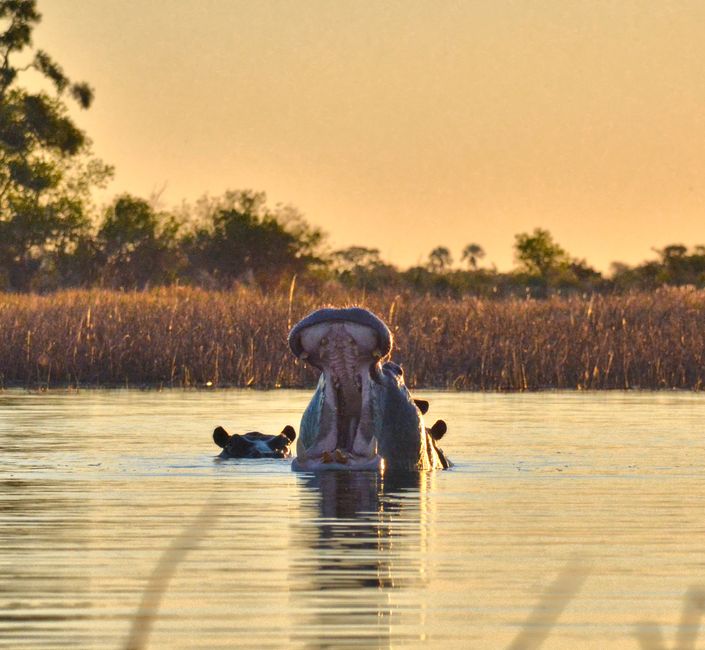
- Permanent channels and lagoons: hippopotamus, Nile crocodile, African fish eagle
- Flooded grass and sheltered wetlands: red lechwe, sitatunga
- Woodland islands and dry edges: African elephant, Cape buffalo, giraffe, lion, leopard
Experiencing Mokoro Days and 4x4 Game Drives Well
Mokoro etiquette that keeps wildlife calm
A successful mokoro safari is quiet, controlled, and respectful of the waterway. To reduce disturbance:
Keep distances that allow animals to choose their own space. If wildlife reacts strongly—standing fully alert, retreating suddenly, or changing direction repeatedly—adjust immediately. For boats, smooth paddling and steady movement are more important than speed. Avoid steering close to steep banks or over fragile reedbeds where your canoe could damage habitat.
Your guide should also explain the “no-go” areas based on safety and environmental sensitivity. In floodplain systems, those boundaries change as water level changes, so what worked yesterday may not work tomorrow.
4x4 pacing, positioning, and safe observation
4x4 game drives are most rewarding when the vehicle is used to explore habitat, not to chase animals across terrain. When animals are feeding or resting, observation improves when you position where they can continue their behaviour with minimal disruption. If a sighting is brief, it’s better to note the sign and move toward likely habitat edges rather than repeatedly circling.
Safety matters on the ground too. Watch for track congestion, soft ground near drainage lines, and unpredictable vehicle handling after rain. A responsible team follows established routes and avoids unnecessary off-road driving.
Switching modes smoothly as conditions change
If your itinerary includes both mokoro and game drives, the most enjoyable days are usually those that keep the “story” of the habitat coherent. For example, a mokoro morning that focuses on channel edges can set you up for a 4x4 afternoon that explores adjacent woodland islands. Guides will adjust this based on flood level, but the guiding principle stays the same: move from one habitat type to the next in a way that matches animal movement and access.
Ethics, Safety, and Conservation When Planning Moremi
Distance, noise, and habitat protection
Wildlife welfare should guide every movement choice. In Moremi’s wetland system, you’ll often be close to where animals feed and drink, so small decisions add up. Avoid blocking paths that animals are using naturally, and don’t interpret signs of curiosity as permission to approach.
Respect also applies to the water itself. Don’t stir up more mud than necessary, and don’t linger in places where bank vegetation is easily damaged. For mokoro, that means gentle navigation and a willingness to change route if conditions become risky or habitat damage looks likely.
Health, weather, and waterborne risks
Wetland safaris bring practical risks: heat, biting insects, sun exposure, and water-related hazards. Your team should brief you on what to do if weather changes quickly, how to manage insect bite prevention, and where it’s safest to move if visibility drops.
From a planning perspective, it helps to schedule activities with realistic margins. Flood-level itineraries can shift because channels change faster than people expect, and rushing to “stick to the plan” can increase risk.
Working with guides and getting your dates right
Good mokoro and 4x4 safari planning relies on local interpretation of water conditions. Choose an operator and guide team that explains route decisions clearly, discusses safety and wildlife distance before you start, and shows flexibility when the flood doesn’t match expectations. For securing accommodation dates that align with your intended flood window, Booking.com can be a simple way to check availability across camps and travel periods.
Overall, the key to a great Moremi mokoro and 4x4 safari is matching your route to the flood level, using your mode of travel where it actually works best, and planning wildlife viewing around habitat rather than luck. When you choose channels and edges thoughtfully, switch to game drives at the moment boat travel becomes inefficient, and aim for reliable species in the right environments, you end up with a trip that feels rich, safe, and considerate of the reserve you came to enjoy.
Leave a Reply